
What Is an I Statement — and Why Use It?
A simple way to share how you feel without turning the conversation into blame.
Key ideas
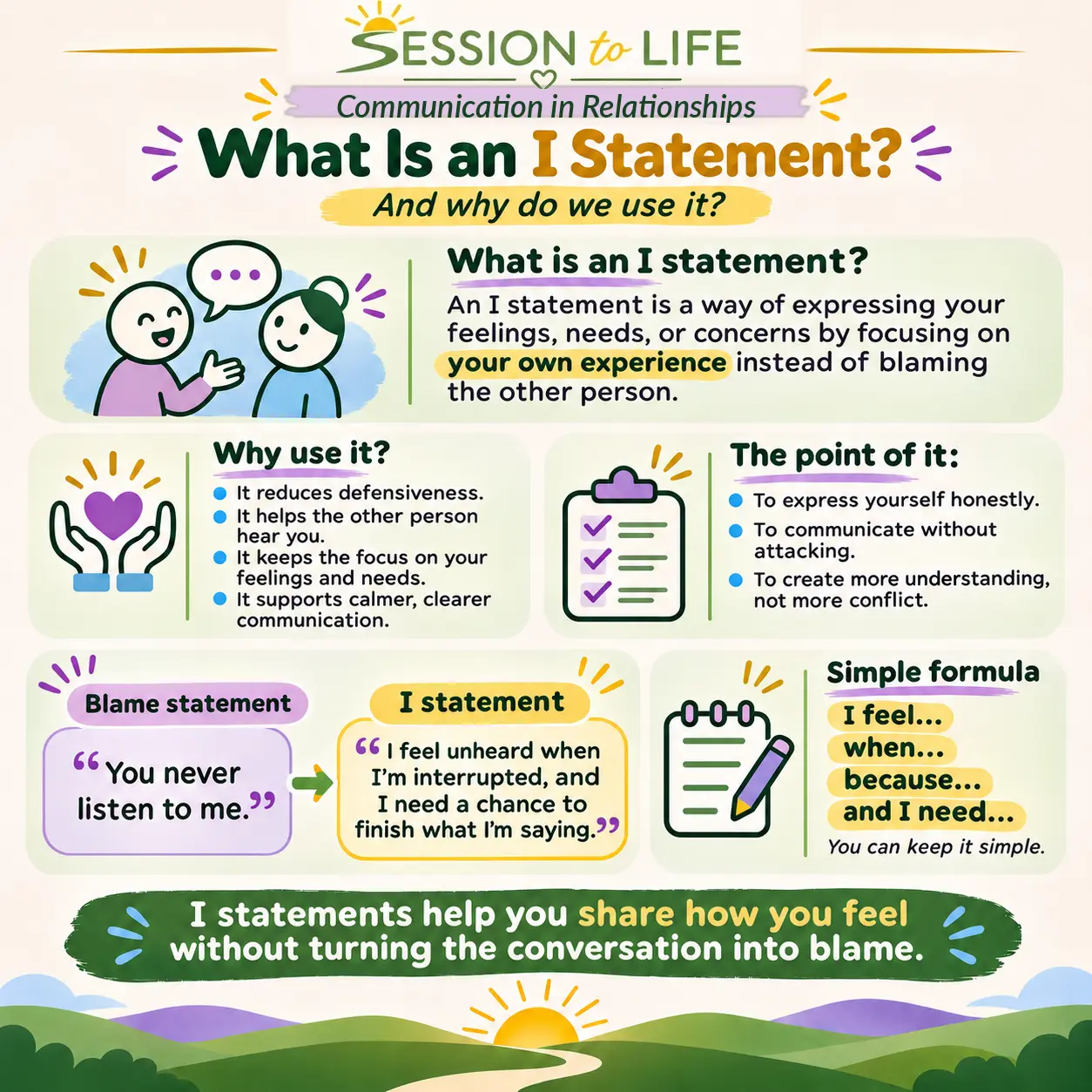
- An I statement focuses on your own experience instead of blaming the other person.
- It reduces defensiveness and helps the other person really hear you.
- Formula: I feel… when… because… and I need…
Blame vs. I statement
Blame: “You never listen to me.” I statement: “I feel unheard when I'm interrupted, and I need a chance to finish what I'm saying.” The first invites a defense. The second invites understanding.
The point of it
To express yourself honestly, to communicate without attacking, and to create more understanding instead of more conflict. It keeps the focus on your feelings and needs, which no one can argue with.
Keep it simple
You don't have to use every part of the formula. “I feel overwhelmed and I need a few minutes” works. Avoid sneaking blame back in, like “I feel that you're selfish.” That's still a “you” statement.
Try this
Think of a recent complaint that started with “You always” or “You never.” Rewrite it using: I feel… when… because… and I need…
Time Boundary Scenario
A coworker asks you to stay late again, but you already feel stretched thin and need to go home.
ReadEnergy Boundary Scenario
Someone wants to keep talking and making plans, but you already feel mentally and physically drained.
Read